America Does Not Negotiate. It Subjugates

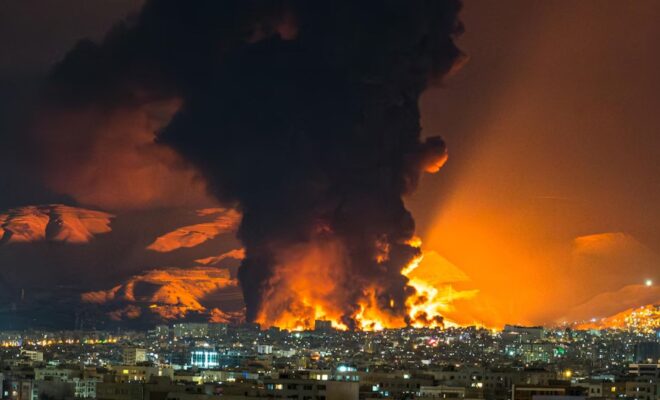
On February 28th, the US and the Zionist Entity launched a series of air and missile strikes on Iran, striking the latter’s nuclear energy sites, military infrastructure, and regime leadership.
The assault led to the killing of Ali Hosseini Khamenei, Iran’s top-most cleric and political figure, alongside many other leaders of the Islamic Revolutionary Guard Corps (IRGC).
In addition, the US and Zionists have murdered over 3,000 civilians (including innocent young children in schools and hospital patients). The UN estimates that over 330,000 people across Iran have been displaced due to the strikes, with economic costs expected to reach billions of dollars per day due to disruptions in oil/gas supplies and market shocks.
Once again, the US has embroiled the Muslim lands in another conflict designed to fulfill the interests of the American capitalist elite. This issue is not new to the Ummah, as it has seen such wars before in Iraq, Yemen, Syria, Afghanistan, and other places.
However, it is crucial to examine the events that led to the current conflict, specifically how the US carried out these strikes while negotiating with Tehran. Not only that, but Tehran was in the process of submitting to each of America’s demands, but the US attacked Iran anyway.
The Iran-US War
Indeed, only hours before the US began “Operation Epic Fury,” Oman’s foreign minister and key mediator – Badr Albusaidi – said: “I can see that the peace deal is within our reach. I’m asking to continue this process because we have already achieved quite a substantial progress in the direction of a deal.” When the attacks began, Albusaidi said, “I am dismayed. Active and serious negotiations have yet again been undermined.”
Likewise, Iran’s foreign minister – Abbas Araghchi – said on February 28th: “A team of Iranian negotiators were talking with US special envoys Steve Witkoff and Jared Kushner in Geneva… and a deal was at our reach.” Several days later, Araghchi added: “The fact is that we don’t have any positive experience of negotiating with the United States… We negotiated twice last year and this year, and then in the middle of negotiations, they attacked us.”
On March 5th, Araghchi got to the heart of the issue itself, stating: “We negotiated with them (the US) twice, and every time they attacked us in the middle of negotiations? So there is no request for a ceasefire by us, and there is no request for negotiation with the US from us.”
From Araghchi’s statements, one crucial point becomes clear: America does not negotiate; it only subjugates. This is not just a reality for Iran or even the Ummah, but the entire world, be it with Canada, Europe, Russia, China, or anyone else. The US does not honour the agreements it signs, it does not compromise, and it will never prioritize the interests of others over its own. Instead, the US imposes its vision of how things should work, and that vision will always, without exception, place the interests of the American Capitalist elite at the top, even if it costs everyone else their livelihoods, their well-being, or even their lives.
Consider Iran, for example. Tehran voluntarily suspended its nuclear weapons program back in 2003, and by 2005, it voluntarily opened its facilities for inspections by the International Atomic Energy Agency (IAEA). In 2015, Iran signed onto and finalized the Joint Plan of Action (JCPOA), which forced it to develop its nuclear energy technology in a way that it could not have any technical pathways to developing weapons-grade plutonium or uranium.
Despite all these concessions (which basically nullified its nuclear weapons program), the US unilaterally withdrew from the JCPOA in 2018-2019. In fact, despite intensified US sanctions, Iran continued to adhere to the terms of the JCPOA. Moreover, in March 2025, the Director of National Intelligence, Tulsi Gabbard, testified that Iran was “not building a nuclear weapon.”
On every turn, Iran surrendered its security interests to the US, but when the US changed its plans for Iran (e.g., instigating a conflict), those concessions did not matter. Ultimately, Iran was forced to fight the US, except without the strategic benefits of nuclear weapons (which might have given Iran a deterrence edge against the US).
America Never Honours Its Promises
Today, Iranian officials are complaining about how the US was dishonest and ill-intentioned, but this is how America always functions, starting from its very first days after its formation as a nation.
In 1832, for example, the US Supreme Court voted 5-1 to recognize the Cherokee Nation as a sovereign entity and forbade the State of Georgia from imposing its authority in Cherokee territory.
But President Andrew Jackson declined to enforce the court’s ruling and then bought out a specific faction of the Cherokee to sign over their rights to the US.
In 1887, the Dawes Act led to the US government stripping over 90 million acres of tribal land from the Native Americans. The goal of the policy was to create divisions among the Natives and eliminate the social cohesion of the tribes.
In 1903, the Supreme Court ruled that Congress could legally abrogate the provisions of any treaty signed with Indian tribes. The legal ruling established that treaties signed with the US were not worth the paper they were written on, as the US could break them at any time. This became known as the “Lone Wolf Doctrine.”
These examples show that when the US signs agreements, it does so either to bide its time or to lay the groundwork for its next steps. However, to America, such agreements are not binding, nor do they hold any intrinsic value. The whole world is now experiencing this reality, from tariffs imposed on exports to the US, to threats of war or annexation.
In fact, the JCPOA with Iran was structured so that Iran was forced to make concessions, while the US had the option to lift sanctions and could opt not to. And even that one-sided deal was not enough to stop the US from ultimately attacking Iran. If anything, negotiations or deals with the US serve more as traps for the other countries, ensnaring them into either depending on the US (e.g., for trade, investment, etc.) or surrendering their own national interests.
The Trap of Negotiating With the US
These traps are not just limited to US foreign policy; they also drive the global system that the US built through the UN, the World Trade Organization (WTO), NATO, and other international bodies.
The Ummah in Palestine are well aware of this fact, given how many promises they were given about being given a state and protecting their rights by these bodies. Yet, in the end, none of those promises amounted to anything, but instead, they entrenched the Zionist Entity even further.
History shows us that the common underlying theme of American policy is that promises and treaties mean nothing, but that control and subjugation mean everything. From blatant lies to outright aggression, the
US – and the Colonialist Powers at large – will do anything
to oppress others and steal their resources. Thus, there is no negotiating with such predatory powers; the only way to deal with such tyrants is to confront and defeat them.
In fact, this is how Islam actively teaches Muslims to deal with their enemies. In Ramadan, the first Islamic State led by Rasul’Allah (SAW) confronted Quraysh at Badr, and, in turn, eliminated some of the worst enemies of Islam on the battlefield, such as Abu Jahl, Ummayah ibn Khalaf, ‘Uthbah ibn Rabi’ah, Shaybah ibn Rabi’ah, and others.
Likewise, some of the most pivotal battles of Islamic history – e.g., the Battle of Hattin against the Crusaders, the Battle of Ain Jalut against the Mongols, the Conquest of Spain, and the Conquest of Makkah – all occurred during Ramadan. In each of these wars, the Ummah across generations never willingly gave way to its enemies but fought to dismantle them.
The Ummah Must Confront Its Enemies
This is the attitude Rasul’Allah (SAW) taught the Ummah to develop from the beginning. Since establishing the Islamic State in Madinah, Rasul’Allah (SAW) actively confronted the enemies of Islam and worked to dismantle them. There was no compromise with Quraysh, the other Arabs, the Jewish tribes, or even with the Persian and Roman superpowers.
As we enter the final third of Ramadan, it is crucial for us to reconnect with the understanding of how Allah (SWT) wants us to deal with our enemies, and how Rasul’Allah (SAW) taught us to implement those commands. Today, we live in an age where the Ummah desperately needs more Badrs, Hattins, and Ain Jaluts, not compromising with or appeasing the Kuffar.
However, getting to that point requires our Ummah to restore the Khilafah Rashidah. Why? Nationalistic states, militia groups, or armed individuals cannot carry out the confrontation required and not authorized by Shariah to do so. The Khilafah is the only system that will unite the Ummah. More importantly, it is also an obligation (fardh), and its restoration must be treated with urgency. The absence of the Khilafah is a fundamental problem, both in dunya and for our aakhirah.
Rasul’Allah (SAW) said: “The Imam is a shield, behind whom the Muslims fight and by whom they are protected.” (Sahih al-Bukhari)