Celebrating Eid: The Ummah’s Unbroken Smile

With the conclusion of another blessed Ramadan, Hizb ut Tahrir Canada would like to extend our sincere congratulations to the Muslim community in Canada, and to the Islamic Ummah at large, on the occasion of Eid al-Fitr. The month of Ramadan was an opportunity for us to renew our intentions and strengthen our obedience to Allah (SWT). We ask Him (SWT) to accept from all of us our fasting, our duas, our Qiyām, our good deeds, and to make us among those freed from the Fire.
As we celebrate Eid with our friends and loved ones on this joyous occasion, our hearts remain heavy with the condition of the Muslims at large. This blessed Eid arrives at a time when our Ummah is standing at one of its lowest points. Across the world, the suffering of Muslims unfolds before our eyes: genocide in Gaza, the continuous slaughter in Sudan, deadly airstrikes in Afghanistan, to aggression against the people of Iran. On every inch of this earth, the Ummah bleeds. Should we be celebrating in the face of such unbearable trauma and disasters befalling us?
The Essence of Eid is Obedience
With the devastating state of the Ummah today across the world, it would be understandable to feel a sense of guilt or uneasiness about celebrating and rejoicing while our brothers and sisters suffer on such a global scale. On the other hand, going about our daily lives as usual while blatant acts of injustice are being meted out would be turning our back on the Ummah. Allah (SWT) commands us to glorify him, irrespective of the situation. He (SWT) says:
“So that you may complete the prescribed period (Ramadan), and glorify Allah (takbir) for guiding you, and that you may be grateful.” [TMQ 2:185].
Ibn Kathir notes that several scholars have stated that reciting takbir during Eid al-Fitr is specified by this verse. A later classical scholar, Ibn Rajab al-Hanbali, made the following comment on the verse:
“Say: In the bounty of Allah and in His mercy—so in that let them rejoice…” [TMQ 10:58]
“Eid is a time of joy and delight. The joy of believers in this world is really in their Lord, when they are blessed to complete obedience to Him and receive the reward of their deeds, trusting in His promise of bounty and forgiveness.” (Lata’if al-Ma‘arif)
Hafiz Ibn Hajar al-‘Asqalani stated in Fath al-Bari that, “Expressing joy on the Eids is from the symbols/features of the religion”.
In the hadith of Anas ibn Malik, the Prophet (SAW) told the people of Madinah that Allah (SWT) had replaced their old festival days with two better days: Eid al-Fitr and Eid al-Adha, which shows that Islam did not abolish celebration but redirected it.
All these evidences demonstrate that glorifying the name of Allah (SWT), wearing one’s best clothes, and being in a joyful mood is from the Sunnah of the Prophet (SAW) and an act of worship. This is why in spite of the bombs, blockades and betrayals unleashed on the Muslims, the Ummah celebrates Eid as a special and festive day despite our enemies’ evil efforts to break our will and our smiles on this blessed occasion!
The Inner Meaning of the Eid Takbir
On the day of Eid, we can hear the loud chanting of the Eid takbir until the start of the Eid Prayer. When we reflect on the meanings and historical context of its words, we learn that they go far beyond just repeated chants of praise. We are reminded that Allah promises Islam’s victory, His (SWT) support for the Messenger (SAW) and the believers and that honour, and success come from Allah (SWT) alone.
It is reported that when the Prophet (SAW) returned to Makkah as the head of the Islamic State in the 8th year after Hijrah, he rode up to the Ka’bah and recited the famous du’a:
“Lā ilāha illallāh waḥdahu, ṣadaqa wa’dahu, wa naṣara ‘abdahu, wa hazama al‑ahzāba waḥdahu.”
“There is no god but Allah alone; He fulfilled His promise, granted victory to His servant, and alone defeated the confederates.”
It was a fulfilment of Allah’s promises to the early Muslims, who were once powerless, oppressed, and surrounded by hostile tribes but now had returned as victorious and opened Makkah. What lessons can we learn when we consider our situation today?
The Messenger’s Mission Remembered
The significance of what we recite during Eid is very important in today’s context. These phrases collapse major Islamic historical events as a summary the Prophet’s (SAW) mission to establish the first Islamic State and invite humanity to Islam.
There are countless examples of Allah (SWT) fulfilling His promise in the life of the Messenger (SAW). The first major event was the Battle of Badr where the 313 Muslims of the newly formed Islamic State defeated an army of over 1,000 Qurayshi fighters. The Prophet (SAW) continuously rejected all forms of compromise and negotiations with the Quraysh.
When we recite “And He alone defeated the confederates” this refers to the Battle of the Trench in when a coalition of 10,000 enemy soldiers surrounded Madinah and tried to annihilate the Muslims once and for all. The Quraysh had formed a massive alliance with Arab and Jewish tribes specifically to crush Islam. While the Muslims used a trench as a tactic, it was ultimately Allah (SWT) who caused the coalition to fail.
The phrases we recite during Eid, should not be based on inherited traditions. Instead, it should make us realize that our time is in many ways, just like the time of the Prophet (SAW): the coalition of the disbelieving colonial powers and the agent-rulers actively plotting and fighting the return of the Khilafah in the Muslim World. However, just like the Messenger (SAW), we should refuse to waver in our mission to establish the Khilafah state while placing our complete trust in Allah’s (SWT) promise that there will be Khilafah on the path of Prophethood and the Muslims will once again be victorious irrespective of how the reality appears to us.
Attempts to Silence the Name of Allah
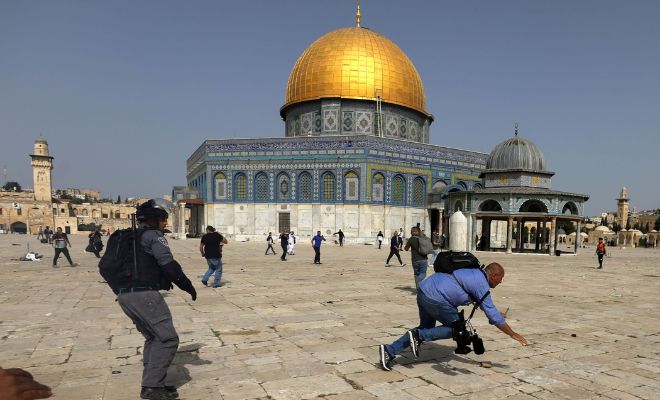
While many of the minarets around the world resound with takbir, and masjids were recently filled with worshippers for Eid prayers, after the blessed month of Ramadan, the Zionist entity closed the door of Masjid Al-Aqsa and prevented the Muslims of Palestine from entering during Eid, forcing worshipers to pray outside the Old City, as the Zionist police force barricaded the entrances to the site.
Allah (SWT) says:
“Who does more wrong than those who prevent Allah’s Name from being mentioned in His places of worship and strive to destroy them? Such people have no right to enter these places except with fear. For them is disgrace in this world, and they will suffer a tremendous punishment in the Hereafter.” [TMQ 2:114]
As well, the despicable regimes, not only limit or prevent the Muslims from using the facilities of the masjids but also wish to wipe out the remembrance of Allah (SWT), as they work to secularize Islam on one hand, while others actively striving to demolish, burn, or ruin the houses of Allah (SWT) when given the opportunity. The wars waged by the disbelieving colonial powers and their agents against Muslims in Palestine, Lebanon, Iran, Kashmir, Sudan and many other places show how the minarets, domes, and masjids are deliberately targeted, with shells and weapons of destruction intentionally.
Celebration comes with Liberation
During Eid we are encouraged to celebrate abundantly as this action pleases Allah (SWT). At the same time, imagine the celebration of the Ummah when we will achieve the pleasure of Allah (SWT) through the liberation of the Muslim lands with the establishment of a righteous Khilafah. Let us aim to work for the unity of the Ummah, and mobilization of the resources, technology, and military might of the Muslim lands to defeat the occupiers and oppressors. We should take hope from the following ayah that Allah (SWT) has promised to grant us victory if we work according to the Sunnah of RasulAllah (SAW).
“Allah has promised those among you who believe and do righteous deeds, that he will of a surety grant them in the land, inheritance (of power), as He granted it to those before them; that He will establish in authority their deen, the one which He has chosen for them; and that He will change (their state) after the fear in which they (lived), to one of security and peace.” [TMQ 24:55]