The Major Defense Cooperation Partnership (MDCP) between the United States and Indonesia
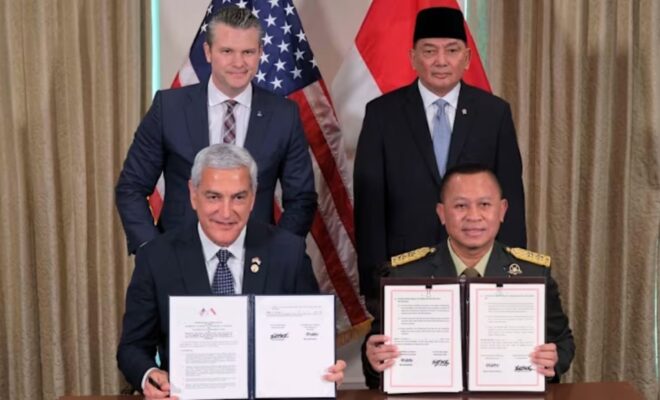
Question: On April 13, 2026, the U.S. Secretary of Defense and the Indonesian Minister of Defense announced the establishment of the Major Defense Cooperation Partnership (MDCP) between the United States and Indonesia. Prior to this, a classified document from the U.S. Department of Defense was leaked regarding a “blanket overflight” authorization for U.S. aircraft through Indonesian airspace. What is the substance of this agreement and its implications? To what extent will it affect Indonesia’s relationship with the U.S. and its relationship with China?
Answer:
To clarify this matter, we review the following points:
1. The Joint Statement (April 13, 2026): The joint statement noted: “The U.S. Secretary of Defense and the Indonesian Minister of Defense announced the establishment of the Major Defense Cooperation Partnership (MDCP)… emphasizing the strength and potential of bilateral defense ties. The MDCP aims to serve as a guiding framework for enhancing bilateral defense cooperation. With this announcement, both countries reaffirm their shared commitment to maintaining peace and stability in the Indo-Pacific region.” The MDCP is built on three main pillars implemented on the basis of mutual respect and national sovereignty:
-
Pillar I: Military modernization and capacity building.
-
Pillar II: Professional military education and training.
-
Pillar III: Exercises and operational cooperation.
2. The Leaked Secret Document: Two days before the joint statement, the Sunday Guardian (India) revealed on April 12, 2026, that a classified U.S. Department of Defense document uncovered a plan to secure blanket passage for U.S. military aircraft through Indonesian airspace. This followed a February meeting between Indonesian President Prabowo Subianto and President Donald Trump in Washington. This represents a significant step in expanding U.S. operational influence in the Indo-Pacific. During his visit to attend the Board of Peace (BoP) summit (Feb 18–20, 2026), Prabowo reportedly agreed to this proposal during a bilateral meeting with Trump.
3. Operationalizing U.S. Overflight: The newspaper added that the U.S. Department of Defense forwarded a document titled “Operationalizing U.S. Overflight” to the Indonesian Ministry of Defense on February 26. The document proposes a formal understanding allowing U.S. military aircraft to pass through Indonesian airspace for contingency operations, crisis response missions, and agreed-upon military exercises. Crucially, the document specifies that “U.S. aircraft may transit immediately upon notification, until subsequent notification of de-activation by the United States.”
4. The Strategic Geography and Legal Loophole: Indonesia’s vast archipelago stretches over 5,000 km from east to west, spanning vital air corridors between the Indian and Pacific Oceans. Under Article 53 of the UNCLOS, designated Archipelagic Sea Lanes (ALKI)—such as the Sunda, Lombok-Makassar, and Aru Sea lanes—grant specific transit rights to ships and aircraft that Indonesia cannot suspend. However, these lanes primarily run North-South.
The Danger: U.S. operational routes linking Guam, the Philippines, Australia, or Diego Garcia often run East-West. Under Indonesian Law No. 37 of 2002, these East-West routes are not part of designated archipelagic lanes. This agreement grants access to these specific corridors that the U.S. State Department has argued since 2014 should be open under international law.
5. Ambiguity and “Crisis Response”: The term “crisis response” is broad enough to cover anything from humanitarian aid to a strike package. “Contingency operations” could range from disaster relief to operations in the South China Sea. Under a “blanket overflight” system, Indonesia cannot effectively distinguish between these operations on a flight-by-flight basis. If a U.S. plane crosses Indonesian airspace for a military operation against a third party, Indonesia becomes an intermediary—whether Jakarta intends to be or not.
6. China’s Position: The Global Times (Chinese state media) reported on April 17, 2026, that Foreign Ministry spokesperson Gu Jiakun, when asked about the overflight proposal, stated: “The ASEAN Charter and the Treaty of Amity and Cooperation (TAC) explicitly state that member states share a responsibility to promote regional peace… and may not participate in any activity, including the use of their territory, that threatens the sovereignty and territorial integrity of member states.” He added that defense cooperation should not target the interests of third parties or harm regional stability.
7. Regional Context: In the Indo-Pacific, the U.S. has mutual defense treaties with Japan, South Korea, the Philippines, Thailand, and Australia. While Singapore is not a treaty ally, it is a “Major Security Cooperation Partner” under a 2005 framework. This new MDCP elevates Indonesia’s status toward a similar level of strategic integration.
8. Conclusion and Strategic Implications: Analysis of the MDCP reveals:
-
Control over the Strait of Malacca: The treaty paves the way for increased U.S. naval presence and control over the Strait of Malacca—the primary energy artery for China, Japan, and South Korea. Most of China’s oil and gas imports pass through this narrow corridor.
-
Military Infrastructure: The agreement sets the stage for establishing comprehensive repair, maintenance, and overhaul (MRO) facilities for U.S. military assets, particularly warships, within Indonesia.
By granting these rights, Indonesia risks shifting from its traditional “independent and active” foreign policy toward becoming a central link in the U.S. strategy to contain China.