How the Regimes Are Stealing the Ummah’s Rights
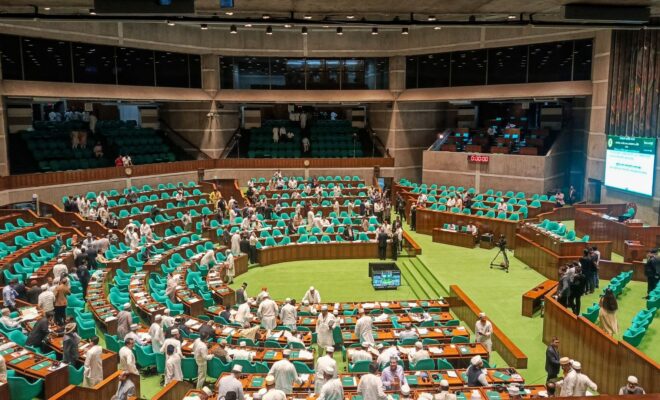
Ever since the fall of the Uthmani Khilafah in 1924, the Muslim world has experienced nothing but tyranny, injustice, and betrayal. The false borders, created by the colonial powers, were only designed to divide and weaken the Ummah and distance it from its once glorious past. The current regimes ruling the Muslim lands do not represent the will of the people, which is the implementation of Islam. Rather it only represents the interests of their foreign masters and a handful of elites. This is done through a variety of ways, one of which is deceiving the people using the parliamentary system to deprive the Muslims of any say in their own affairs.
Examples of this can be seen in recent months, as regimes in Algeria and Bangladesh have begun taking steps to strip away the Ummah’s capacity to hold them accountable. In both cases, we are seeing the regimes use the parliamentary system to essentially steal the Ummah’s right to organize, protest, and hold rulers accountable.
Algeria
The Algerian ruling regime – through the parliament – is close to securing the power to arrest, prosecute, and execute potential political opponents.
On October 1st, the People’s National Assembly (APN) passed a penal code amendment that expands the death penalty. The bill’s capital offences include the deliberate burning of forests and fields, child abduction, and the destruction of public or private property on behalf of foreign parties. It also applies the death penalty to “anyone who attempts to undermine public security and order, national unity or economic and environmental stability.”
In this instance, the regime bundled the punishment for heinous crimes that the public would agree need to be punished (e.g., child abduction) with other ones (e.g., the “undermining public security”) that are vaguer and more open to interpretations by judges and prosecutors.
Beyond being deceptive, the Algerian ruling regime has no right or mandate to legislate such laws, or any laws. The current lower house – elected on 2 July and seated later that month – drew a turnout of 20.88%, i.e., about 79% of the Algerian electorate did not vote. Nearly one in five ballots cast was invalid, so valid votes for all parties equal 16.9% of registered voters.
The FLN and the pro-establishment RND, the two largest parties, hold 165 of 407 seats on votes equal to 5.6% of registered voters. Roughly one-third of the would-be candidates were disqualified before the vote, so it is unclear how much of even that turnout is inflated. Thus, the regime does not represent Algerian people.
The other, and more important, issue is that legislation – or law-making – belongs solely to Allah (SWT). Only the Creator has the right to determine what is right and wrong, which also includes the right to decide how society should conduct itself, define what actions constitute crimes, and to prescribe punishments for those crimes.
No one else has this right, and, certainly, no ruler or collection of elites (i.e., parliament) can decide who should live or die for an action. Those who usurp such power are cut from the same cloth as Fir’aun, the king who argued against Ibrahim (AS), and Abu Jahl, all of whom would decide (always wrongly and unjustly) who would live and die. And of them, Fir’aun and Abu Jahl used this power to murder the believers.
Bangladesh
In Bangladesh, Prime Minister Tarique Rahman’s BNP has refused to carry out the July Charter through the process voters approved. On 17 February, BNP officials took their oath as members of parliament but declined a second oath as members of the Constitution Reform Council, which was mandated to enact the Charter’s constitutional reforms within 180 working days.
The BNP promises to amend the constitution through parliament instead, but on the terms it signed – i.e., with its notes of dissent. However, those dissents are different from what it promised. Therefore, upon taking power, the BNP decided it could change course as per its will rather than a commitment to the public, even when that commitment (i.e., Charter) was in itself a significant compromise and betrayal of the Ummah’s sacrifices. It shows that there is no limit to the regimes’ willingness to violate their promises and to take from the Ummah.
We are an Ummah That Actively Accounts
The events in Algeria and Bangladesh are a problem for the Ummah on multiple levels.
Firstly, the Arab Spring, the uprisings in Syria, the protests in Pakistan since 2021, the protests against the Hasina regime in Bangladesh, and so on, establish that the Ummah organizes and protests to demand change. And, in every case, the Ummah always organizes and protests as peacefully as it can until the regimes’ thugs interfere with violence. What these legal changes aim to do is nip dissent in the bud by completely freezing the environment of any urge and will to hold the authorities accountable. Not only that, but the regimes can now neutralize this dissent with the full force of the law, backed by the legitimacy of parliament.
Secondly, the regimes are using the parliament (or national assemblies) to build legitimacy, but they never actually have the public’s support or mandate. These parliaments are filled only with regime loyalists and allies (while the Ummah’s true voices are disqualified and/or jailed), and, as one can see in Algeria, draw on the mandate of a tiny minority of the total population. Yet, these institutions are now deciding for the entire public and are legislating laws in the public’s name – even when they have no right to do so.
Thus, our challenge as an Ummah is that, yes, although we are ruled by oppressive regimes, autocrats, and groups, we are also ruled under oppressive systems. As we saw in Iraq, Egypt, Libya, Syria, Bangladesh, and so on, rulers can – and do – fall. However, if the systems under them are not completely removed (and replaced with the Islamic systems of ruling, economy, law, foreign policy), the oppression remains and, more often than not, becomes worse.
Moreover, these systems all take different forms, from dictatorships to democracies, but in the end, they all serve one function: to repress the Ummah. Each time the Ummah rises or stands against these systems, they come back harder with even greater oppression.
Keeping all this in mind, we should reflect on this narration from the era of the second Khalifah, or Amir of the Muslims, Umar ibn-al-Khattab (RA).
During a Jummah khutbah, Umar ibn-al-Khattab (RA) asked the congregation, “What will you do, my friends, in case I deviate from the truth one day?” Replying to Umar (RA), a man rose and said, “When you willfully deviate from the truth, we will withdraw our allegiance to you and I for one would feel it my duty to kill you with my sword.” Umar then praised Allah (SWT) for giving the Ummah people who would hold even the caliph accountable.
Can one imagine anyone telling any of the rulers in the Muslim lands that they would not only stop obeying them, but that – if they broke from ruling by Islam – they would stand up to the ruler? This is the difference between the system that had ruled the Muslim lands from the time of Rasul’Allah (SAW) to the early 1900s, and the systems oppressing the Ummah today.
In the Islamic system, i.e., the Khilafah, Allah (SWT) made the ruler accountable to the Ummah. The Khalifah (Caliph) was required to implement Islam and only Islam – nothing else. In other words, they did not have the freedom or right to deviate from Islam or introduce their own ideas or adopt foreign systems.
If they deviated from ruling by Islam, then the Ummah was empowered – and obliged by Allah (SWT) – to remove them, for Allah (SWT) said:
“But no, by your Lord, they will not [truly] believe until they make you, [O Muhammad], judge concerning that over which they dispute among themselves.” [Surah anNisa’a 4:65]
“And judge, [O Muhammad], between them by what Allah has revealed.” [Surah al-Ma’ida 5:49].
And this is the hukm that the narration from the time of Umar (RA) reflected. During the Khilafah Rashidah, the Sahaba (RA) understood that holding the ruler or the establishment accountable was critical. Allah (SWT) gave the Ummah that right and duty.
We now need to ask what we must do to restore the Islamic system, i.e., Khilafah, on our lands. The Khilafah was in our lands for over 1,400 years, during which our rulers implemented – and implemented only – the ahkam or Commands of Allah (SWT). And the Ummah could hold them accountable at every step, ensuring that those rulers remained on the straight path. That is what led to the widespread justice and prosperity the lands of the Khilafah became known for.
And, as with all aspects of life, Allah (SWT) provided us with the method for restoring the Khilafah, even in a time and place full of darkness and oppression, as we see today. We will find those instructions in the life of Rasul’Allah (SAW), specifically from the steps he took (via Wahi) to establish the first Islamic State in Madinah. It is an obligation (fardh) for us to restore the Khilafah upon the method of Rasul’Allah (SAW) as it is the only way out of this era of darkness and tyranny. May Allah (SWT) hasten the victory of the Ummah. Ameen.